
Volkswagen Golf 5 (2003–2008) fuse box location and fuses
Updated:
The Volkswagen Golf 5 has 3 fuse boxes. The first is here: left end of the dashboard behind a cover (open the driver's door). Below we show where to find the fuses for the cigarette lighter, ABS, engine control unit, fuel pump, lights and wipers, and what to do if a fuse keeps blowing.
Always verify against the label on the box lid. Fuse layouts change with year and equipment.
Where the fuse boxes are
- 1Left end of the dashboard behind a cover (open the driver's door)
- 2Engine bay, left side next to the battery, in a box with a lid
- 3On top of the battery (large strip fuses, a workshop job)
The diagram shows roughly where the boxes are, not the fuse layout.
Always check the lid or owner's manual: VAG changed fuse numbering by model year and equipment, so a 2005 and a 2008 car can differ.
1 Left end of the dashboard
How to open it
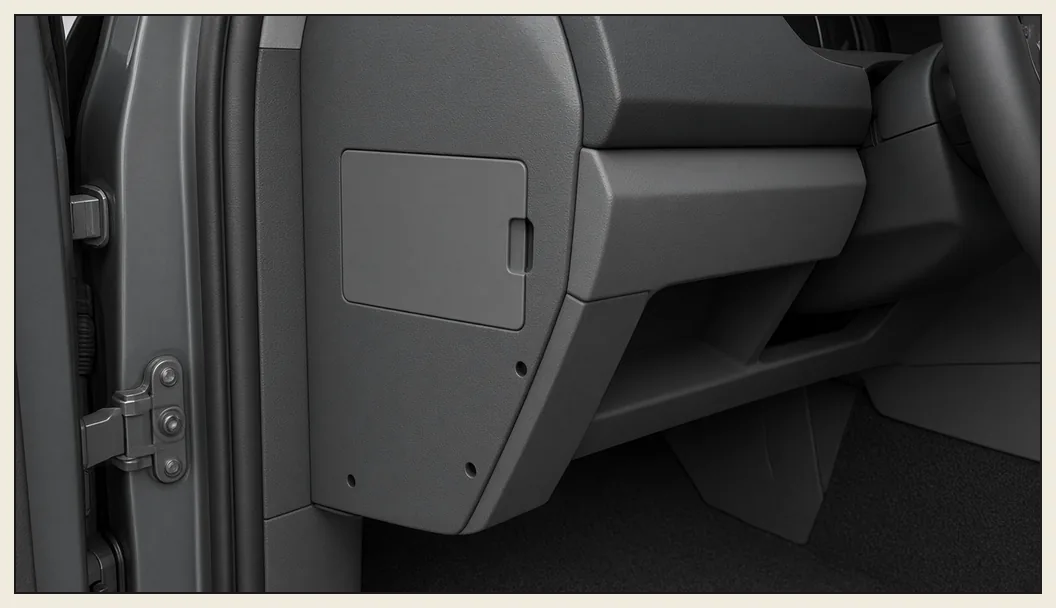 Illustration
- Open the driver door. The fuse box cover is on the end of the dashboard (1).
- Hook a finger into the notch (2) and pull the cover towards you.
Fuses
Arrangement from public diagrams
| Colour | No. | A | What it powers |
|---|---|---|---|
| 24 | 25 | Cigarette lighter (up to 05/2006) | |
| 42 | 20 | Cigarette lighter / front socket (from 05/2006) | |
| 26 | 20 | 12 V socket in the boot (up to 05/2006) | |
| 27 | 15 | Fuel pump control unit | |
| 41 | 15/20 | Rear wiper (15 A up to 05/2006, then 20 A) |
Slot arrangement and shape are drawn from public fuse box diagrams (several sources agree); model year and equipment can differ, so check the lid. Colour shows the amp rating per ISO 8820. Grey hatched “?” = amps unconfirmed, no colour claimed. White slot = no data for it. R = relay.
42: One source lists 15/20 A
Fuse colour code
- 5 A tan
- 7,5 A brown
- 10 A red
- 15 A blue
- 20 A yellow
- 25 A clear/white
- 30 A green
- 40 A orange
- ? unverified
2 Engine bay, left
How to open it
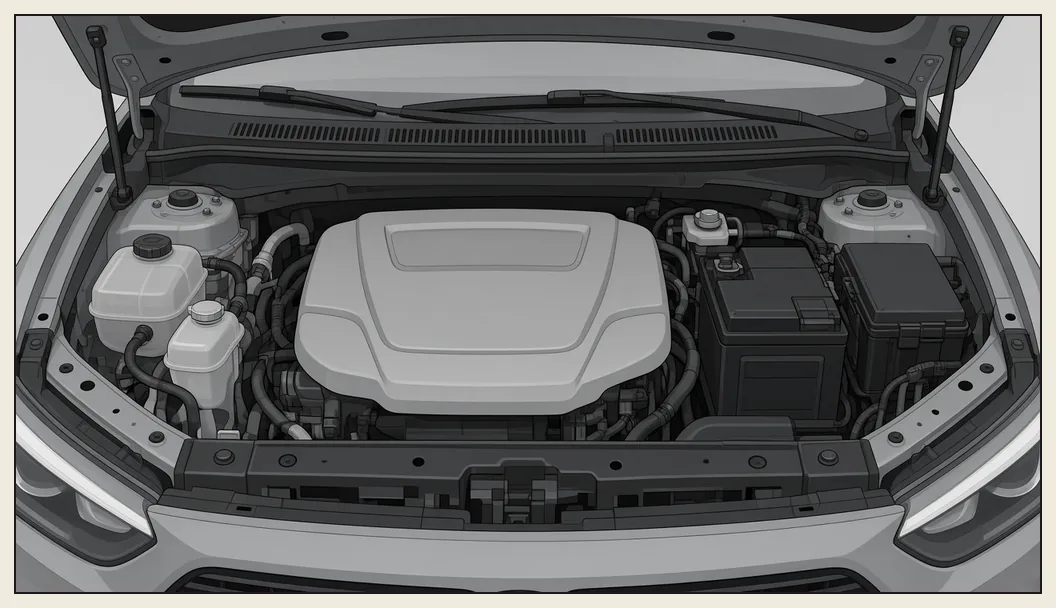 Illustration
- Open the bonnet. The fuse box is next to the battery (1).
- Press the clip on the front edge of the cover (2) and lift the cover off.
Fuses
Schematic arrangement
| Colour | No. | A | What it powers |
|---|---|---|---|
| F17 | 15 | Horn (version 1) | |
| F19 | 30 | Front wipers (version 1) |
The arrangement is schematic (number order) because no source confirms this box's physical layout. Only the fuses in the table are shown. Colour shows the amp rating per ISO 8820. Grey hatched “?” = amps unconfirmed, no colour claimed.
Fuse colour code
- 5 A tan
- 7,5 A brown
- 10 A red
- 15 A blue
- 20 A yellow
- 25 A clear/white
- 30 A green
- 40 A orange
- ? unverified
3 On the battery
How to open it
Large strip fuses sit on top of the battery. Leave these to a workshop if you're not sure about disconnecting the battery.
The engine-bay box exists in two versions with different numbering. The cabin box changed in May 2006.
Sources
We compared public fuse tables and owner-manual extracts. An entry counts as confirmed when number and function match in at least two sources.
Common faults and fuses
Cigarette lighter / 12 V socket dead
Look for the socket or cigarette symbol, usually 15–20 A
ABS light on
ABS usually has two fuses: pump (large, 30–60 A) and control unit (5–15 A)
Related fault code: P0500
Engine won't start, dash lights on
The engine control unit (ECU) fuse and main relay are in the engine-bay box
Related fault code: P0606
Fuel pump silent at key-on
Look for the fuel pump symbol, usually 15–25 A, often with a relay
Related fault code: P0230
One headlight or tail light out
Bulb first, then fuse. On many cars a body control module drives the lights and there's no separate fuse
Wipers not working
The wiper fuse is large (20–30 A). If it's fine, the relay or motor is often to blame
How to check a fuse
Switch the ignition off and pull the fuse with the plastic puller. A blown fuse has a broken wire inside. Fit one of the same rating. If the new one blows straight away, there's a short in the wiring that needs diagnosing.
Data confidence: medium
Want a definite answer?
Bring the car to our workshop in Estonia for diagnostics. We read the fault codes, test the sensors and tell you what is wrong. Repair price depends on the work involved, generally €45 per hour.